
2025 SUSTAINABLE INDUSTRIAL PROCESSING SUMMIT AND EXHIBITION,
Cebu, Philippines, FLOGEN, 2025
THE ALTRUISTIC COMPONENT OF SUSTAINABILITY: FUNDING OF YOUNG SCIENTISTS – A SUCCESS STORY
Martin Bultmann1, Eva Roblegg2, Cornelia Sonntag3
1University of Heidelberg, Heidelberg, Germany;
2Institute of Pharmaceutical Sciences, Pharmaceutical Technology and Biopharmacy, Graz, Austria;
3Galenus Privatstiftung, Wien, Austria;
Keywords: foundation, funding for academia, workshops, junior professorship, guest professorship
ABSTRACT
Young researchers in academia face a lot of hurdles while establishing their scientific careers. They are caught up in a series of traps where one can’t be overcome by overcoming all the others as well: time, funding, publishing, research, teaching, being present at conferences, expanding their skillset, building and getting into networks etc. All those topics are intertwined; all shall be served at once and all at the fullest extent possible.
Consequentially, this situation has a high potential of becoming a vicious circle unless it is broken at one or more points.
Here, foundations can set in and help in multiple ways to break the circle and overcome this conundrum effectively. One example is the Galenus-Privatstiftung [1], a non-profit scientific foundation that aims to support postdocs, habilitation candidates, assistant and junior professors in the field of pharmaceutical technology and biopharmacy. The foundation awards the Galenus Supports, the Technology Prize, enables visiting professorships as well as international workshops.
INTRODUCTION
When young scientists decide to pursue a career in academia and even took the first hurdle and got one of the few available permanent positions, they embark on a journey that comprises a lot of additional obstacles: acquiring project funding, negotiating for lab space, setting up a new lab including equipment, recruiting a workgroup, combining research work and teaching obligations, publishing the scientific results etc. and especially important: building their scientific network.
Therefore, young scientists find themselves trapped in triangles when bootstrapping their scientific career. They are requested to prove themself great researchers through their scientific work as soon as possible, but they also need to secure funding, which requires significant time for preparing grant proposals (fig 1). One can try to find a trade-off optimum of all three components but will never be able to have all three at maximum levels. A similar predicament is the trias of scientific work being divided into research, teaching and publishing.
There will also be trade offs; one can not have all three to the fullest extent at the same time. An additional caveat is publishing as mentioned elsewhere [2], which might consume lots of the already scarce funding for paying publisher fees for open access journals [3] [4]. Time is also required to build a network and to extend the skillset.
EDUCATION AND SCIENTIFIC ADVANCEMENTS
With quality education being one of the 17 UN sustainability goals [5], education shall not be thought of as just acquiring literacy, but more as a holistic lifelong comprehensive and unlimited learning opportunity. This also comprises higher education, access to scientific publications, skillset advancement, knowledge sharing and exchange through workshops, conferences or student-exchange programs and visiting-professorships.
ACADEMIA AND UNIVERSITIES
The role of scientists is to serve on both ends: They should spread their knowledge as multipliers to the students to fulfill the educational aspect and on the other hand, their genuine curiosity will lead to constant knowledge acquisition, lifelong learning, research and scientific advancement.
Universities should promote both aspects equally: teaching and scientific advancement and allow scientists to concentrate on those two aspects. However, funding is usually the Achilles’ heel.
Another important aspect is networking. Most universities are organized in department centric structure [6]. Cross department collaboration requires active push and will for collaboration and exchange. Ideally, this is not just limited to neighbouring faculties but also extends across universities both nationally and internationally. Again, this is also a matter of funding.
Some, but not all universities already have concepts in place that support young academic research careers, for example through central institutions such as the Research Careers Campus. Competence- and community-building measures provide researchers at all career stages with the tools to seize opportunities. Services such as micro-funding, networking opportunities, personalized counselling and external coaching are tailored to the respective career stage. Such institutions support not only the maintenance and improvement of scientific excellence, but also the strengthening of the positive research culture of universities [7].
Additional recommendations on how to nurture young scientist e.g. by addressing lack of resources, and material, mentoring, adapting to realities of women and family issues are mentioned in [8].
FUNDING
Typically, even the most efficient institutes have a hard time funding resources, consumables, equipment, conferences and publications from their allotted household budgets. They rely on external funding through industrial cooperations, which then consumes noticeable resources for contract work and not always yield publishable results due to IP (intellectual property) restrictions. Another opportunity for external grants are large governmental or non-governmental funding organizations like DFG (Deutsche Forschungs-Gemeinschaft, German Research Foundation) or FWF (Österreichischer Wissenschaftsfonds, Austrian Science Fund), FFG (Österreichische Forschungsförderungsgesellschaft, Austrian Research Promotion Agency). However, grant application writing is also very time consuming, and success depends on availability of (limited) funds and whether the proposed topic meets the scope and/or scientific Zeitgeist of the funding organization.
ROLE OF FOUNDATIONS
This is where public or even private foundations can set-in to break the above mentioned vicious circle.
GALENUS FOUNDATION, ACHIEVEMENTS AND IMPACT
One successful example is Galenus-Privatstiftung, a non for profit foundation privately funded in 2004 in Vienna and dedicated to support young researchers (postgraduates, assistant professors, etc.) in the field of pharmaceutical technology and bio-pharmacy and headquartered in Vienna, Austria.
A major aspect of the foundation’s work is its financial awards, such as the Galenus Supports and the Galenus Technology Prize.
GALENUS SUPPORTS
The Galenus supports (500 €) are annual awards meant to cover travel expenses, access to academic literature, laboratory equipment, opportunities to formally present research activities.
GALENUS TECHNOLOGY PRIZE
The foundation believes that innovation is of paramount importance for scientific development. Bi-annually since 2005, the foundation acknowledges and rewards those who display exceptional innovative thought with the Galenus Technology Prize. The award is worth €5,000.
VISITING PROFESSORSHIPS
Galenus Foundation also financed a series of Galenus Visiting Professorships to foster connections between the various universities, major institutions and research groups throughout Europe and also to North America and Asia.
INTERNATIONAL WORKSHOPS
During the past two decades and in addition to its awards, the Galenus Foundation has also enabled a number of International Workshops on topics ranging from protein analytics, pulmonary drug and dermal delivery, nanocarriers and other delivery systems, medical devices, particle and bioengineering, to human in vitro models and many more. Typically, these Workshops are also accompanied by poster sessions to foster scientific exchange.
LOW HURDLE
One unique characteristic is also another approach to cut the vicious circle: application is intentionally low hurdle and requires only little prework and time; typically a short project summary for a support and more detailed description of the research project plus max. 3 publications.
IMPACT
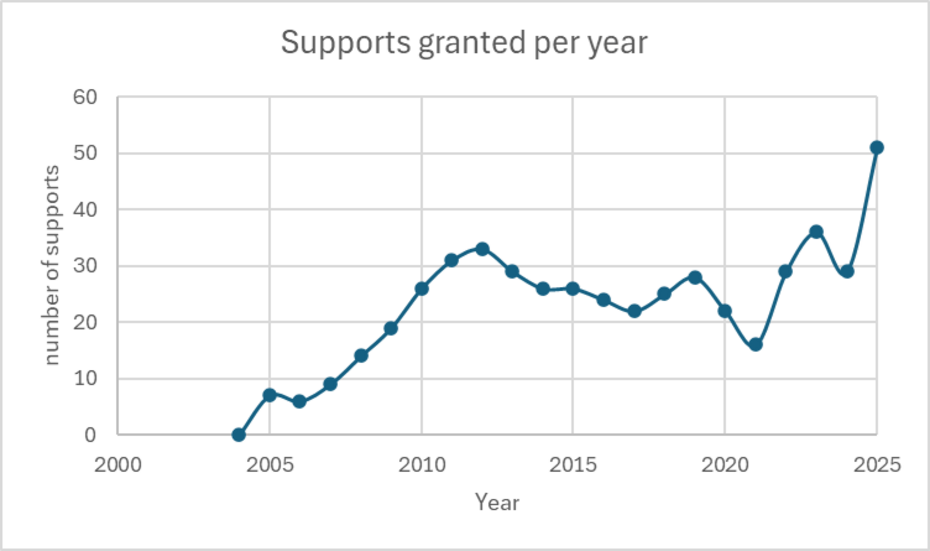
To this date the Galenus Foundation has awarded the Galenus support 500(!) times since the founding in 2004 to young researchers not just from Austria, Switzerland or Germany, but throughout the EU and even worldwide.

The Galenus-Prize has been awarded 11 times to 14 winners (2 winners each in 2007, 2017, and 2023).
Twelve Workshops have been organized throughout Europe (D-Munich, IE-Dublin, D-Greifswald, D-Saarbrücken, Charite (D-Berlin), D-Würzburg, D-Frankfurt, CH-Geneva, AT-Graz, ES-Valencia, IT-Parma, PT-Porto) and 19 visiting professorships resulted from the foundation’s efforts.
Despite all the achievements mentioned above, there’s one invaluable addon: The social events like dinners and/or sightseeing tour sat outstanding locations (Cirağan palace, Istanbul; Palais Lobkowitz, Vienna) come with the Galenus Prize ceremony, the workshops and visiting professorships. They help building a scientific network with a secure family atmosphere, eliminate reservations, that young scientists might have in approaching peers, senior scientists or luminaries in Pharmaceutical Technology or Biopharmacy or related subjects.
FEEDBACK
Since the foundation strives to support young scientists, where it is needed the most, feedback is requested and taken into consideration for continuous improvements.
The following feedback was received mainly from workshop participants and also reflects views of award winners and visiting professors:
Workshop participants praise them for extraordinary organization, the open and welcoming atmosphere and exciting lectures, that cover a broad range of relevant topics.
This means one can not only learn a lot about the own topic but also get input from adjacent fields or new inspiration from a completely different perspective. It also offers the opportunity to establish valuable – also interdisciplinary – collaborations.
Poster presentations also contribute to increasing visibility of one's own research and help to network through the informal atmosphere. Inspiring keynotes and innovative perspectives that provide impetus for own research work, but also for one's own scientific career. Final excellently organized dinners offer a wonderful opportunity to make new contacts outside the scientific setting and leave wonderful and inspiring impressions.
The feedback received from visiting professors and hosting professors points out that these visits offer exceptional opportunities for scientific exchange and international networking. They enable leading researchers to work at another institution for a limited period and to contribute their expertise, thus creating lasting impetus for research, teaching, and the promotion of young talent. The exchange offers new perspective on research and approaches. The scientists benefit immensely from this change in viewpoint. It enables their development, and encountering great resonance and encouragement for their research is also as motivating as inspiring, plus it definitely enhances reputation. Streaming the keynote lecture is an integral part of the visiting professorship. It creates a ceremonial atmosphere during the stay and allows participation from around the globe. To reflect on and further expand these synergies, sessions are organized where the visiting professors shared their experiences with young researchers. Such events impressively demonstrate how much guest professorships contribute to long-term collaborations, joint promotion of young talent, and new scientific ideas.
The general openness of the foundation and request for new ideas and proposals on how to help young scientists best, search for open and direct input are highly acknowledged.
SUSTAINABILITY ASPECTS
Although there is no single definition of sustainability, the various definition approaches yield similar outcomes: The three pillars: social/people, Environment/Planet and Economic well being/profit [9] [10] [11] [12]. Several aspects from government, management, science and technology, civil society, health, equal opportunities, energy, infrastructure, housing situation, jurisdiction etc. are the cornerstones [5]. Yet an underlying prerequisite for all of the above is education from which science arises; the foundation for all of the above [13].
Any means of paving the ground and nurturing young scientists therefore contributes to the roots of sustainability.
CONCLUSION
Young scientists in academia find themselves stuck between a rock and a hard place managing time, funding, publishing, research, teaching, conferences, skillset, and networking. In this situation, which has a high potential of becoming a vicious circle even a little support from the outside can have a tremendous impact.
Foundations like the Galenus Privatstiftung, that are driven not by commercial interests but by the concept of altruism, provide relief in many of the above-mentioned topics: 500EUR supports or 5000EUR technology prizes are already extremely valuable financial enablers while workshops provide skillset enhancement visiting professorships foster scientific bonds and exchange between Universities. Yet, the compelling advantage of small foundations over big institutional organizations is the family style atmosphere as a very fertile seeding ground for forming effective and close networks amongst young researchers – the key protagonists of future science and education.
ACKNOWLEDGEMENTS
The authors highly appreciate the consolidated feedback from Stefanie Gier, Christoph Hauß (workshop participants), Miriam Breunig, Olivia Merkel, and Jean Christope- Leroux (visiting and hosting professors).
REFERENCES
| [1] | Galenus Privatstiftung (website in english) [Internet]. [cited 29.08.2025]. Available from www.galenusprivatstiftung.at/english |
| [2] | Roblegg E, Bultmann M: From “publish or perish” to “publish and perish” – young scientists being struck between science and funding. [proceedings] SUSTAINABLE INDUSTRIAL PROCESSING SUMMIT AND EXHIBITION, Cebu, Philippines, 2025 |
| [3] | Der hohe Preis des Publizierens [Internet]. [cited 25.08.2025]. Available from science.orf.at/stories/3204272/ |
| [4] | Open Access - 9.500 Euro pro Studie [Internet]. [cited 25.08.2025]. Available from science.orf.at/stories/3203164/ |
| [5] | United Nations Department of Economic and Social Affairs: Sustainability Development Goals [Internet]. [cited 22.Apr.2024]. Available from sdgs.un.org/goals |
| [6] | Gentile J, Boehlert S: Nurturing Young Scientists, Science, 2010 p.884 |
| [7] | University of Graz: Was ist der Research Careers Campus Graz? [Internet]. [cited 16.09.2025]. Available from research-careers-campus.uni-graz.at/de/team-organisation/ |
| [8] | Pain E: An Emerging Global Picture of Early-Career Scientists [Internet]. [cited 29.08.2025]. Available from www.science.org/content/article/emerging-global-picture-early-career-scientists |
| [9] | Wikipedia "Nachhaltigkeit" [Internet]. [cited 17.Apr.2024]. Available from de.wikipedia.org/wiki/Nachhaltigkeit |
| [10] | Wikipedia "Sustainability" [Internet]. [cited 17.Apr.2024]. Available from en.wikipedia.org/wiki/Sustainability |
| [11] | Purvis B., Mao Y., Robinson D.: Three pillars of sustainability: in search of conceptual origins, Sustain Sci, 2019 p.681-695 |
| [12] | Kongoli F.: Role of Science and Technology in Sustainable Development. Montreal (Canada): FLOGEN Star Outreach; 2016. p.14.01.2024. |
| [13] | Bultmann, J M: SUSTAINABILITY IN BIG PHARMA – CAN SUPERCOMPUTING DO THE TRICK? [proceedings] SUSTAINABLE INDUSTRIAL PROCESSING SUMMIT AND EXHIBITION, Iraklion, Crete, 2024 |